How to calculate salary tax in Pakistan (FY 2026-27)
Salary tax in Pakistan is progressive: the more you earn in a year, the higher the rate on the top part of your income. Here is the exact method, using the slabs for salaried persons from 1 July 2026.
The slabs
| Yearly income (Rs) | Tax |
|---|---|
| Up to 600,000 | 0 |
| 600,001 – 1,200,000 | 1% above 600,000 |
| 1,200,001 – 2,200,000 | Rs 6,000 + 11% above 1,200,000 |
| 2,200,001 – 3,200,000 | Rs 116,000 + 20% above 2,200,000 |
| 3,200,001 – 4,100,000 | Rs 316,000 + 25% above 3,200,000 |
| 4,100,001 – 5,600,000 | Rs 541,000 + 29% above 4,100,000 |
| 5,600,001 – 7,000,000 | Rs 976,000 + 32% above 5,600,000 |
| Above 7,000,000 | Rs 1,424,000 + 35% above 7,000,000 |
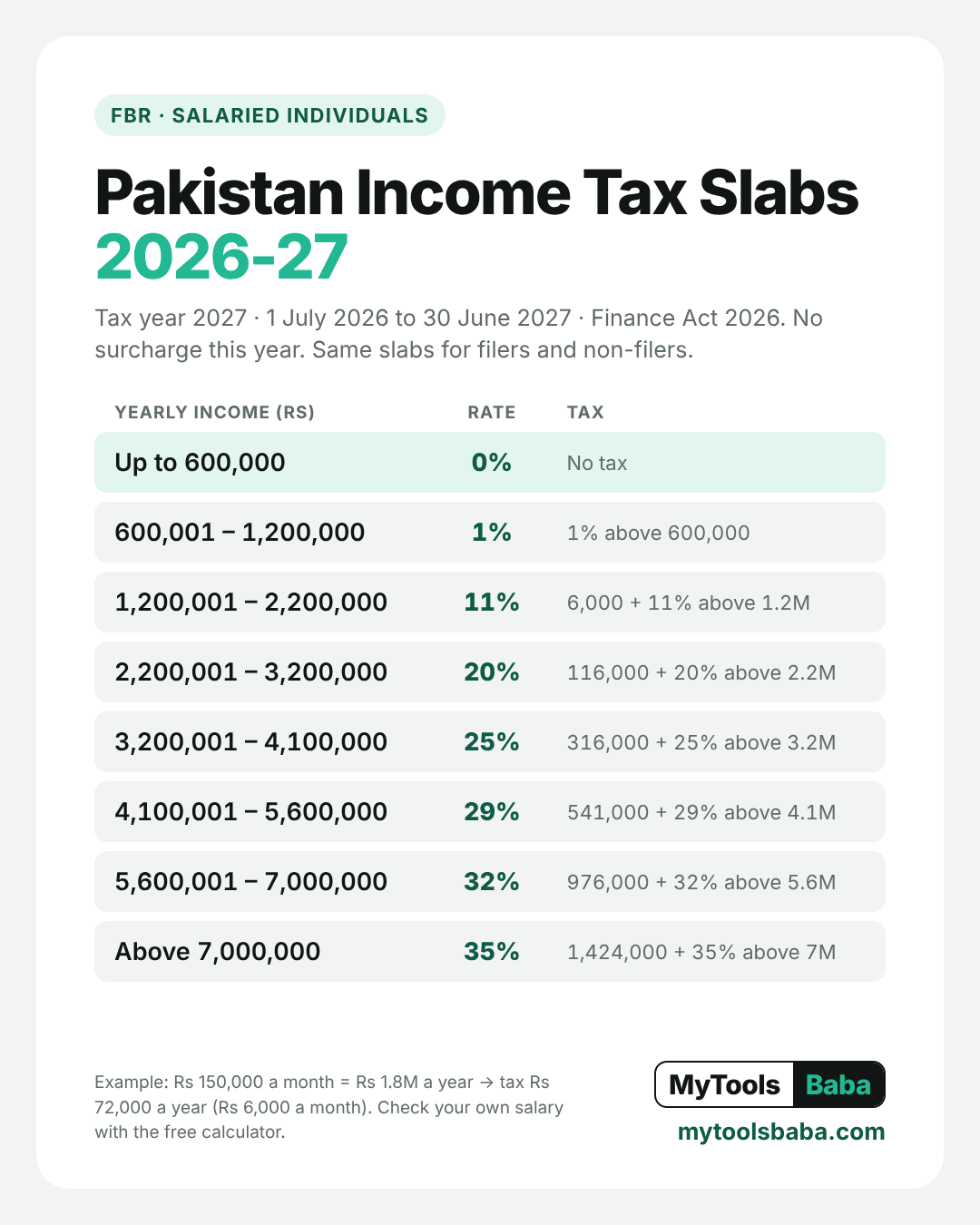
Use this image on your website or blog
You are welcome to share it. Please paste this code so the credit link stays with the image:
Step by step
- Multiply your monthly gross salary by 12 to get yearly income.
- Find the slab your yearly income falls in.
- Add the fixed amount for that slab to the rate multiplied by the income above the slab's starting point.
- Divide the yearly tax by 12 for the monthly deduction.
Tax = fixed amount + rate × (yearly income − slab start)
Example 1: Rs 250,000 a month
Yearly income is Rs 3,000,000, which is in the 20% slab. Tax = Rs 116,000 + 20% × Rs 800,000 = Rs 276,000 a year, or Rs 23,000 a month. Take-home pay is Rs 227,000 a month.
Example 2: Rs 80,000 a month
Yearly income is Rs 960,000, which is in the 1% slab. Tax = 1% × Rs 360,000 = Rs 3,600 a year, or Rs 300 a month.
Salary tax table: monthly salary Rs 50,000 to Rs 500,000 (FY 2026-27)
This table applies the slabs above to common monthly salaries, assuming the salary is your only taxable income and has no exempt allowances or tax credits. The last column shows the monthly tax under the FY 2025-26 slabs, so you can see how much your deduction has changed.
| Monthly salary | Yearly tax | Monthly tax | Monthly take-home | Effective rate | Marginal rate | Monthly tax in FY 2025-26 |
|---|---|---|---|---|---|---|
| Rs 50,000 | Rs 0 | Rs 0 | Rs 50,000 | 0.00% | 1% | Rs 0 |
| Rs 75,000 | Rs 3,000 | Rs 250 | Rs 74,750 | 0.33% | 1% | Rs 250 |
| Rs 100,000 | Rs 6,000 | Rs 500 | Rs 99,500 | 0.50% | 11% | Rs 500 |
| Rs 125,000 | Rs 39,000 | Rs 3,250 | Rs 121,750 | 2.60% | 11% | Rs 3,250 |
| Rs 150,000 | Rs 72,000 | Rs 6,000 | Rs 144,000 | 4.00% | 11% | Rs 6,000 |
| Rs 200,000 | Rs 156,000 | Rs 13,000 | Rs 187,000 | 6.50% | 20% | Rs 13,500 |
| Rs 250,000 | Rs 276,000 | Rs 23,000 | Rs 227,000 | 9.20% | 20% | Rs 25,000 |
| Rs 300,000 | Rs 416,000 | Rs 34,667 | Rs 265,333 | 11.56% | 25% | Rs 38,833 |
| Rs 400,000 | Rs 744,000 | Rs 62,000 | Rs 338,000 | 15.50% | 29% | Rs 71,750 |
| Rs 500,000 | Rs 1,104,000 | Rs 92,000 | Rs 408,000 | 18.40% | 32% | Rs 106,750 |
How to read the table
The effective rate is the share of your whole salary that goes in tax. The marginal rate is the tax on each extra rupee you earn, and it is the one that matters when you negotiate a raise, overtime or a bonus. A salary of Rs 100,000 sits exactly at the top of the 1% slab, so a raise beyond it is taxed at 11%, while a salary of Rs 150,000 is already in the 11% slab and the next slab starts at a yearly income of Rs 2,200,000.
If your salary is not in the table, work it out with the steps above or enter the amount in the salary tax calculator. Salaries between two rows pay a tax between the two figures shown.
What this does not include
Some allowances may be exempt and tax credits (for donations, pension contributions or Zakat, for example) can reduce your tax. Your payslip or annual return can therefore differ from these numbers. Slabs change with the federal budget each year, so check the tax year before you calculate. For filing, use FBR's IRIS portal or ask a tax adviser.
Skip the maths: use the salary tax calculator.
Frequently asked questions
What is the tax-free salary in Pakistan for 2026-27?
Yearly salary up to Rs 600,000 (Rs 50,000 a month) is not taxed under the slabs on this page.
Do I pay tax on each slab separately?
Yes. Only the income inside a slab is taxed at that slab's rate. That is why the method adds a fixed amount for the lower slabs.